Have you ever found yourself pondering over the nature of agate, trying to determine whether it is a rock or a crystal? It’s one of those questions that might not seem like a big deal until someone throws it your way. Suddenly, you’re deep into a geological conundrum that touches on chemistry, mineralogy, and, perhaps, even personal preference. Let’s embark on this fascinating journey together to unravel the intriguing nature of agate, with its swirling patterns and myriad colors, and decide once and for all: is it a rock or a crystal?

Understanding the Basics: Rocks vs. Crystals
Before venturing into the colorful world of agate, it’s crucial to grasp the underlying difference between rocks and crystals. This foundational knowledge will pave the way to a better understanding of agate’s classification.
What are Rocks?
Rocks, in their splendid variety, are the solid and natural aggregates comprising one or more minerals or mineraloids. Each rock is essentially a patchwork quilt of minerals bound together. Think of a rock as a composite dessert. You’ve got your base (minerals) and your tasty toppings (sometimes other minerals or organic material). Hence, a rock can be anything from a humble sandstone to the dramatic landscape linchpin that is granite. Rocks are the storytellers of our planet, documenting geological history with intricate detail.
What are Crystals?
When you dive into the world of crystals, you find yourself face-to-face with a different beast entirely. Crystals are solid materials whose atoms are arranged in a highly ordered, repeating pattern extending in all three spatial dimensions. Imagine well-disciplined dancers at a concert lineup, holding perfectly symmetrical formations. This orderliness is the hallmark of crystals and endows them with distinct geometric shapes—often glossy, sometimes seemingly magical.
The Allure of Agate
Now, onto agate—this here is where the fun begins. What’s not to like about agate, with its vivid colors and mesmerizing bands? Agate has been appreciated for centuries, serving both practical purposes and as a treasure of aesthetic value.
The Formation of Agate
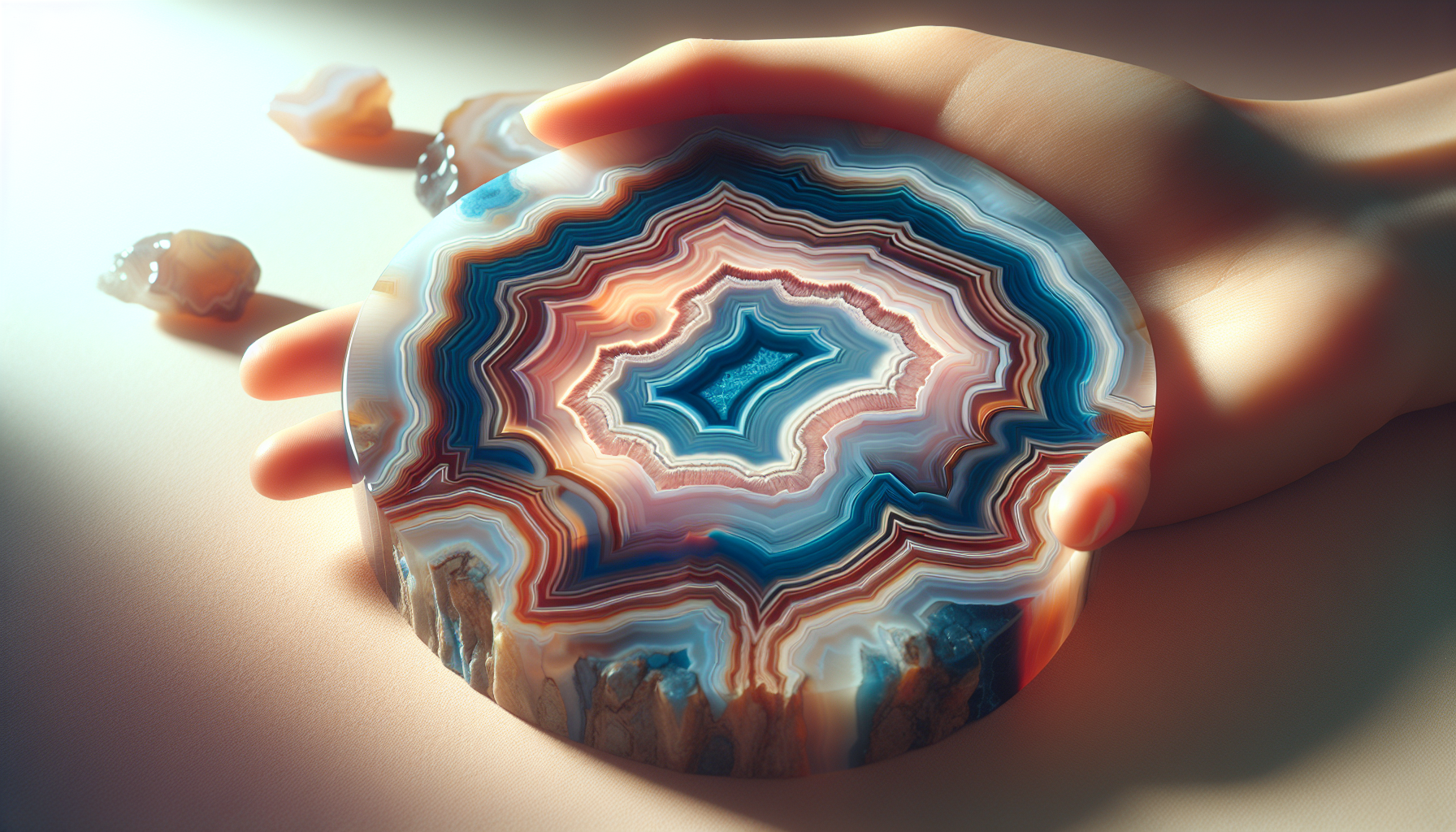
Agate is born from the world’s geological processes—formed primarily within volcanic and metamorphic rocks. Its elaborate bands are the result of the slow deposition of silica-rich solutions into free spaces within the rock matrix, often filling caverns, veins, or other holes created by gas pockets.
Imagine a tiny cavity, the size of a sugar cube, sitting within a rock. Over eons, this cavity gets filled layer by blissful layer with silica-rich fluids. Then, as the quartz slowly cools and crystals form, you get those hypnotic bands of varying transparency and color.
Historical Significance of Agate
Rewind to the times when agate was first discovered—this would take us back thousands of years, to civilizations like the Egyptians, Greeks, and Romans. Agates were thought to possess protective properties. Warriors lugged them into battle, and travelers believed them to be an insurance policy against the evil eye. Today, you might not carry one into battle, but they surely make a fantastic addition to your living room!


Is Agate a Rock or Crystal?
With that solid foundation of understanding, we can now tackle the identity of agate. Is it a rock, or is it a crystal?
Agate as a Rock
To declare agate purely a rock is to view it through the lens of its composite nature. Agate forms within host rocks, like volcanic and metamorphic varieties, serving as the culmination of mineral deposits. If a rock is a composite of various minerals, then agate fits that definition snugly due to its silica and quartz components. Thus, it’s correct to call it a rock, precisely because it is a physical mixture born of complex geological processes.
Agate as a Crystal
On the flip side, to say agate is a crystal emphasizes its mineral composition, dominated by quartz—a crystalline form of silicon dioxide. It’s important to bear in mind: agate’s distinctive banding arises from the microscopic crystalline structure of quartz fibers. These repeating patterns definitely put agate in the crystalline category.
Agate as a Gemstone
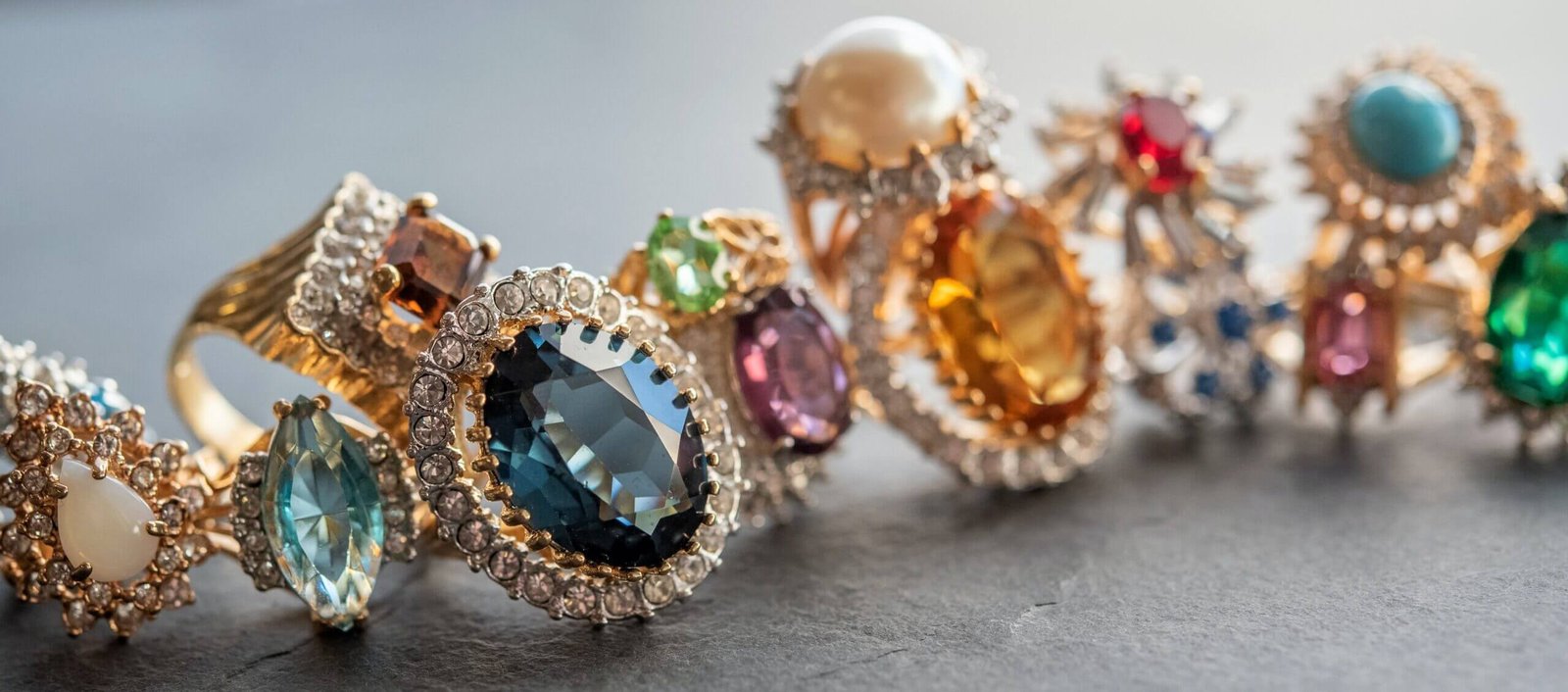
Oh, and let’s not forget—we sometimes refer to agate as a gemstone too. While not entirely fitting the jeweler’s criteria for a gemstone’s perfection and clarity, agate’s affordability, durability, and unique beauty make it a popular choice among artisans today.
| Property | Rock | Crystal | Gemstone |
|---|---|---|---|
| Composition | Mineral mix | Crystalline structure | Gem-quality |
| Structure | Aggregate | Ordered | Attractive |
| Uses | Building, history | Collectibles, metaphysical uses | Jewelry, decor |
Delving Into Agate Varieties
You deserve to know just how deep this agate rabbit hole goes. Agate doesn’t settle for basic; it comes in a veritable parade of varieties, each uniquely stunning.
Moss Agate
Nature lovers, take notice—moss agate could be your new best friend. Its unique, plant-like inclusions resemble lush greenery trapped in glass, as if Mother Nature herself decided to preserve a garden for you. Technically, these greenish or reddish-brown patterns result from embedded minerals, rather than any actual plant life.
Blue Lace Agate
Imagine the sky on a clear, breezy day—a serene image—and you have an idea of what blue lace agate evokes. This variety sports delicate blue and white banding, often symbolizing tranquility and calm. It’s a favorite among those who seek a touch of peace to carry with them.
Fire Agate
Old-school magic in stone form—this is what you get with fire agate. The fiery glints and bright colors come from the light refraction between its mineral layers. Each stone plays host to a tantalizing dance of yellow, red, orange, and green hues, earning it the moniker ‘the spiritual flame.’
The Metaphysical and Healing Aspects of Agate
Whether you’re a skeptic or a believer, it’s hard to deny the allure of gem lore. Agate isn’t merely about looks; it boasts a rich history of metaphysical properties that intrigue many.
Emotional Healing
Agate is said to be the emotional spa treatment you didn’t know you needed. Its grounding properties are believed to enhance mental functions, improve concentration, and offer a stabilizing influence on our emotions, helping transform negative energies into positive ones.
Physical Benefits
If physical wellness is more your concern, legend has it that agate can aid in rejuvenating your body. It’s asserted to support your blood circulation, improve digestion, and even lend a hand with skin ailments. Whether you buy into its alleged abilities or not, cradling a piece of cool, smooth agate in your palm does have a soothing touch.
Balancing and Harmonizing
For those seeking balance in life, agate might serve as a stalwart ally. Some enthusiasts tout its power to harmonize yin and yang, the elements of positive and negative within us. As you carry or wear agate, the suggestion is that it promotes serenity and composure in a rapid-paced world.
How to Identify Agate
Dodging imposters in the world of agate is an adventure on its own. Here are some tips for differentiating genuine agate from pretenders that might cross your path.
Spotting the Real Thing
Authentic agate often displays a glossy, vitreous luster and possesses the trademark bands. It’s hard but not impossible to carve, and feels fairly heavy in your hand. The patterns should appear naturally swirled rather than etched or splotched.
Common Imposters
Sometimes, dyed or synthetically enhanced stones masquerade as natural agate. Be cautious, especially if the price feels too good to be true or if the colors gazing back at you are impossibly vibrant and uniform.
| Feature | Genuine Agate | Potential Imposter |
|---|---|---|
| Luster | Glossy | Dull or overly shiny |
| Weight | Substantial | Surprisingly light |
| Pattern | Natural bands | Definite lines |
| Color, if dyed | Subtle | Unnaturally bright |
| Source transparency | Credible store mix | Online scams storeoloers |
Caring for Your Agate
Never underestimate the power of taking good care of your precious stones. Proper care ensures agate remains gleaming and vibrant for years to come.
Cleaning Your Agate
Regular maintenance involves gentle care. Clean your agate with mild soap and water. A soft brush will help engrained dirt dissolve without scratching the surface. Avoid harsh chemicals—while they might succeed in stripping dirt, they’ll also sap your stone’s natural beauty.
Storing Your Agate
Store your agate in a soft cloth or padded container to prevent it from rubbing against harder materials that could mar its surface. Keeping it away from strong sunlight and extreme temperatures will also help maintain its exquisite appearance.
In Conclusion: Agate—A Rock, A Crystal, A Marvel
So, is agate a rock or a crystal? The answer isn’t as clear-cut as one might hope. It’s both—a fascinating interplay of rock and crystal that captures the imagination with every gaze. Agate’s beauty lies in its duality; it’s just rock enough and just crystal enough to slide stylishly into either category.
But whichever label suits your fancy, what remains indisputable is agate’s role as a historical and aesthetic marvel. It delights collectors, artists, and everyday people, drawing us in with its mystique. Whether in the sands of ancient times or the vibrant curiosity shops of today, agate continues to be admired and cherished by those in the know—and now, that includes you!